 By
By Capacity math that actually predicts fit
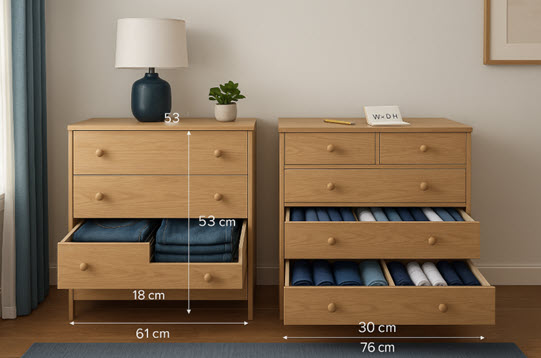
You are staring at two dressers that look nearly identical. One has five drawers. One has six. The tags do not help, the sales floor lighting does not help, and you are trying to guess which one will actually hold more of your everyday clothes. This is where a little friendly math saves you from returns and buyer regret. You do not need spreadsheets. You only need three measurements and a simple way to picture how your clothes sit inside a box.
Start by measuring the inside of a drawer, not the outside. The case and the slides steal space that the eye cannot see. Measure width from left to right, depth from front to back, and height from bottom to top with the drawer closed. Write them down. Almost everything you store fits as a footprint on the drawer floor, so the width times the depth tells you how many items sit in a single layer. Height tells you whether a second layer will stay tidy or collapse into a mess.
Here is a realistic way to think about footprints. A flat folded tee shirt sits on roughly twelve by ten inches. A tee folded in the vertical file style sits on about nine by four inches and stands upright like a book. A pair of jeans folded in half and then in thirds takes about thirteen by eleven inches. A roll of paired socks is about three by three inches. Your numbers may drift a little if you fold tighter or looser, but these are dependable home tested sizes.
Now imagine two dressers that share the same width and depth. The five drawer model uses taller drawers. The six drawer model splits the stack into shorter sections. Give both an inside floor of twenty four by fourteen inches. That is three hundred thirty six square inches to play with in each drawer. The five drawer version gives you seven inches of interior height. The six drawer version gives you five and a half.
Lay flat folded tees on that floor and the math is gentle. Three hundred thirty six divided by a hundred and twenty is a hair under three, but in real life you will fit two tees per layer with space to slide your hand. In a seven inch drawer you can stack three layers without toppling, which yields about six tees. In a five and a half inch drawer you are happier with two layers and about four tees. Switch to the vertical file fold and the story changes. The footprint drops to thirty six square inches. Now the same floor holds nine to ten tees that stand upright, and you no longer care about stacking. In this case the shorter drawer is easier to keep neat.
Jeans tell a clearer story about height. That thirteen by eleven footprint gives you two jeans per layer on the same floor. Each pair wants about two inches of headroom. A seven inch drawer gives you three honest layers and about six pairs. A five and a half inch drawer gives you two layers and about four pairs. If your wardrobe leans heavy on denim, tall drawers put the extra height to work.
Socks are funny because they feel tiny until you count them. A three by three roll means you can place roughly thirty seven pairs on that same floor in a single layer. Socks want about three inches of headroom. A seven inch drawer takes two tidy layers for about seventy four pairs. A five and a half inch drawer takes one full layer and a partial second for about fifty five to sixty pairs. If you share a dresser with a partner or you like bulk packs, you will feel that difference every laundry day.
What does this mean for the choice between five drawers and six The six drawer layout wins when your wardrobe is mostly tees, active tops, and smaller items that live best in the vertical file fold. Shorter drawers prevent over stacking and keep categories clean. The five drawer layout wins when you own many jeans, hoodies, or chunky sweaters. Extra height gives you room for a reliable second or third layer without crushing the bottom items. Many mixed wardrobes actually prefer six drawers because you gain more compartments and fewer toppling piles.
When you plan your layout, picture whole drawers by category rather than a buffet inside each one. A six drawer dresser might run tees in the top two, jeans in the third, socks and underwear in the fourth, loungewear in the fifth, and seasonal items in the sixth. A five drawer dresser might keep tees up top, jeans in the second, socks and underwear in the third, loungewear and sweaters in the fourth, and a seasonal or overflow drawer at the bottom. If you live light, try a grab and go top drawer that holds a week of outfits. Five tees, two pants, three gym pieces, one sweater, and undergarments ready to roll. Everything else stays in back stock so the top drawer stays calm.
Slides deserve a short look because they change how space behaves. Light duty slides can sag under a stack of jeans and steal height right where you need it. Full extension slides let you file fold to the very back so the floor area works for you. If you plan to double layer denim, choose a dresser with stronger slides or traditional wood runners that feel solid at full pull.
Labels keep systems alive after week two. You do not need anything fancy. Tape a small card inside the top edge of each drawer so you see it as the drawer opens. Tees. Active tops. Jeans. Casual pants. Socks. Underwear. Loungewear. Sleepwear. Gym sets. Base layers. Seasonal. Repairs or donate. When the label tells you what belongs, you stop making micro decisions and the drawer stays consistent without effort.
Here are the buying rules that simplify everything. If most of your clothes are lightweight tees and gym tops, go with six drawers. If you keep many jeans, hoodies, or thick sweaters, five drawers put the height to use. Always ask for the interior height of the shortest drawer. Anything under five inches can pinch a row of file folded tees and limit dividers. If you are in a store, load two folded jeans into a drawer and pull it all the way out. If the front dips, the slides are weak. Pick a sturdier model.
The takeaway is simple. Measure the inside. Picture your clothes as honest footprints. Do a quick floor area check and a quick height check. Six shorter drawers shine for file folded tees, socks, and clear categories. Five taller drawers shine for denim, sweaters, and bulky layers. When in doubt, apply the little bit of math above to your own wardrobe and you will bring home the dresser that fits the way you really dress.